
A basic care guide for isopods, mostly aiming to help the beginner. Chapters include: choose a suitable housing – what to feed – how much humidity – how to breed isopods, and other useful tips for novice breeders of isopods. As you will see by reading this article, keeping pet isopods was never easier.
updated: 1 January 2026
Read time: 28 minutes
Housing > Diet > Humidity & Temperature > Breeding > FAQ
Isopodaria for high humidity > Size of isopodaria >Isopodaria for moderate humidity > Isopodaria for low humidity > Colonies crashed > Transferring isopods to a new container > CB to WC differences
Housing
Isopods require a relatively higher humidity, compared to other arthropods. There are for sure some isopods that require less humidity, but all isopods need a certain percentage of humidity to stay alive.
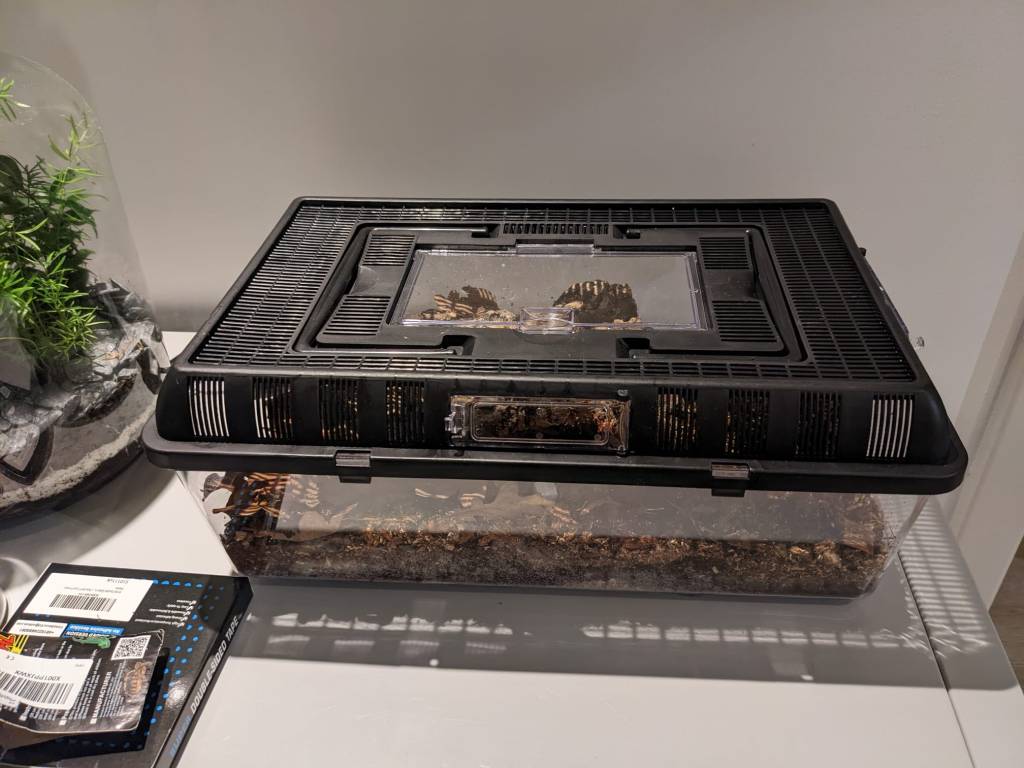
I have seen, unfortunately beginners housing isopods inside faunaria, which are totally unsuitable for keeping isopods, as they cannot hold humidity, and the isopods will dry out and eventually die. The isopodaria (terraria for isopods) need to be closed with only a few openings here and there. The number and placement of the openings depends on the type of the isopod. Generally speaking, there are the isopods that require high humidity, moderate humidity, and low humidity. It is preferred the openings to be on the sides of the isopodarium, and not on the lid.
Housing > Diet > Humidity & Temperature > Breeding > FAQ
Isopodaria for high humidity > Size of isopodaria >Isopodaria for moderate humidity > Isopodaria for low humidity > Colonies crashed > Transferring isopods to a new container > CB to WC differences
Isopodaria for High Humidity
Isopods that require high humidity are mostly isopod species from tropical areas, such as Ardentiella species, to have a general idea, though there are some others as well. The isopodarium for those species needs to have a few openings, like 3 or better 4. Even though they require high humidity, good air flow is usually of critical importance, as the stagnant air might kill them. The isopodaria are plastic storage boxes, but you may keep them inside a terrarium as well. Glass looks nicer, but is heavy. And when one has many isopods, terraria become counterproductive. Personally speaking – and most of us – I keep my isopods in plastic storage boxes, after I modify them to be suitable for housing isopods. Another important aspect is the size and type of opening. In general, openings above 6 cm across, are considered large, and 4 cm is preferred. The type of the opening translates to the use of mesh. Keeping openings without mesh is not recommended for various reasons.
- There are isopods that are able to vertically climb on smooth surfaces, such as all Ardentiella species, some Cubaris species, and a few other tropical isopods.
- Other forms of life (pests) can easily enter from the openings without a mesh, such as ants, fruit flies, mites and others.
I make these air vents with an ultra fine mesh, exactly to prevent / support all those factors I have mentioned above. Now back to the isopodarium for isopods requiring high humidity. We have mentioned the size and number of openings. But for isopods that can vertically climb on smooth surfaces, you have the option to use an escape-proof isopodarium. All other sizes of isopodaria are:
Isopods on our inventory that require high humidity are:
Cubaris murina ‘Anemone’, Cubaris murina ‘Glacier’, Cubaris murina ‘Mandarin’, Cubaris murina ‘Papaya’, Cubaris sp. ‘Blonde Ducky’, Cubaris sp. ‘Caramel Cream’, Cubaris sp. ‘Citrus’, Cubaris sp. ‘Dark Phipun’, Cubaris sp. ‘Giant Mandarin’, Cubaris sp. ‘Giant Nguyen’, Cubaris sp. ‘Honeymoon Tiger’, Cubaris sp. ‘Jupiter’, Cubaris sp. ‘Lemon Blue’, Cubaris sp. ‘Orange Tiger Surat Thani’, Cubaris sp. ‘Panda King’, Cubaris sp. ‘Penguin’, Cubaris sp. ‘Pink Panda King’,Cubaris sp. ‘Platin Tung Song’, Cubaris sp. ‘Rubber Ducky’, Cubaris sp. ‘Red Edge Albino’, Cubaris sp. ‘Red Panda King’, Cubaris sp. ‘Salmon’, Cubaris sp. ‘Silver Tiger’, Cubaris sp. ‘Snow Queen’, Cubaris sp. ‘Tapir’, Cubaris sp. ‘Thai Angel Blue’, Cubaris sp. ‘White Shark’, Cubaris sp. ‘Wang Lung Tiger’, Laureola sp. ‘Durian Spiky’, Ardentiella sp. ‘Black Hole’, Ardentiella sp. ‘Blister’, Ardentiella sp. ‘Ember Bee’, Ardentiella sp. ‘Pink Lambo’, Ardentiella sp. ‘Pink Lemonade’, Ardentiella sp. ‘Red Diablo’, Ardentiella sp. ‘Tricolor’, Ardentiella sp. ‘Volcano’, Ardentiella sp. ‘Yellow Phoenix’, Sinodillo sp. ‘Red Head’, Spherillo sp. ‘Dream’, Trichodillidium pubescens, Trichorhina tomentosa, Troglodillo sp. ‘Camouflage’, Troglodillo sp. ‘Sunset’.
Size of the isopodaria
The size of the isopodarium (container or bin for isopods), depends on the size of the isopod. For example small species, like Cubaris murina ‘Anemone’, Cubaris sp. ‘White Shark’ etc. can live forever in a 2 liter isopodarium. Medium size isopods, like Armadillidium beieri, Porcellio haasi ‘Light’ etc. can live forever in a 4,5 liter isopodarium, or larger. Large size isopods, such as Porcellio hoffmansseggii ‘Ultra White Antenna’, Porcellio magnificus etc are better to house them in a 12,5 liter isopodarium. The size of the isopodarium might be chosen also according to the prolificacy rate of the specific isopod species. For example isopods such as Armadillidium badium ‘High Yellow’, Armadillidium granulatum ‘Naranjito’ and others are extremely prolific isopods. Therefore you might want to house them in a 12,5 liter isopodarium from the beginning. Or you would need to change their isopodarium after 4 to 5 months that their colony is expected to explode.
Housing > Diet > Humidity & Temperature > Breeding > FAQ
Isopodaria for high humidity > Size of isopodaria >Isopodaria for moderate humidity > Isopodaria for low humidity > Colonies crashed > Transferring isopods to a new container > CB to WC differences
Placement of items in the isopodarium (high humidity housing)
First thing I do is to place a few charcoal pieces on the bottom and on the rear side of the isopodarium. Close to them I put horizontally some twigs from white hardwood trees, such as beechwood, birchwood, hazel, oakwood etc. Next, I cover the bottom with Premium substrate or Ultra premium substrate, the depth of which depends on the needs of the specific isopod. For example Porcellio dilatatus loves to dig into the substrate, so the substrate for them has a depth of 8 cm at least. For other species the depth is approximately 5 to 6 cm. Then I cover half of the isopodarium with decaying leaves and on top I place forest moss. For isopod colonies requiring high humidity the moist part is usually 1/2.
Watering (high humidity housing)
How much water? For isopods requiring high humidity I use squeeze bottles with various size nozzles for slow or fast watering of their moist part in the isopodarium. And I also use a sprayer.
Housing > Diet > Humidity & Temperature > Breeding > FAQ
Isopodaria for high humidity > Size of isopodaria >Isopodaria for moderate humidity > Isopodaria for low humidity > Colonies crashed > Transferring isopods to a new container > CB to WC differences
Isopodaria for Moderate Humidity
Isopods that require moderate humidity may have less openings, like 3. But compared to the isopodaria for isopods requiring high humidity there are no significant differences. The difference that you need to create is to the arrangement of the inside of the isopodarium and the space you give for the dry part and the moist part respectively.
Isopods on our inventory that require moderate humidity are:
Agabiformius lentus, all Armadillidium spp., Armadillo officinalis ‘White Pina’, Armadillo officinalis ‘Israel’, Cristarmadillidium muricatum, Cylisticus convexus ‘Ukraine Pied’, Eluma caelata, Cubaris sp. ‘Amber Firefly’, Cubaris sp. ‘Cappuccino’, Cubaris sp. ‘Orange Freezy’, Cubaris sp. ‘Pak Chong’, Cubaris sp. ‘White Head Ducky’, Oniscus asellus, Porcellio dilatatus, Porcellio laevis albino, Porcellio laevis ‘Orange’, Porcellio laevis ‘White’, Porcellio laevis ‘White Caramel’, Porcellio monticola ‘Orange’, Porcellio scaber ‘Dalmatian’, Porcellio scaber ‘Ghost’, Porcellio scaber ‘Moonstone’, Porcellio scaber ‘Orange’, Porcellio scaber ‘Piebald’, Porcellio scaber ‘Whiteout’, Porcellio selomai, Porcellio silvestrii, Porcellio sp. ‘Alanya’, Porcellio sp. ‘Antalya’, Porcellio sp. ‘Orange Skirt’ (Portugal), Porcellio spinipennis ‘Canton de Grasse’, Porcellio werneri, Porcellio werneri ‘Silverback’, Porcellionides pruinosus ‘Powder Orange’, Porcellionides pruinosus ‘Red Koi’, Porcellionides pruinosus ‘Whiteout’, Schizidium rausi, Trachelipus caucasius, Trachelipus trilobatus.
Placement of items in the isopodarium (moderate humidity housing)
First thing I do is to place a few charcoal pieces on the bottom and on the rear side of the isopodarium. Close to them I put horizontally some twigs from white hardwood trees, such as beechwood, birchwood, hazel, oakwood etc. Next, I cover the bottom with Premium substrate or Ultra premium substrate, the depth of which depends on the needs of the specific isopod. For example Porcellio dilatatus loves to dig into the substrate, so the substrate for them has a depth of 8 cm at least. For other species the depth is approximately 5 to 6 cm. Then I cover ⅓ of the isopodarium with decaying leaves and on top I place forest moss. For isopod colonies requiring moderate humidity the moist part is usually 1/3.
Watering (moderate humidity housing)
How much water? For isopods requiring moderate humidity I use squeeze bottles with various size nozzles for slow or fast watering of their moist part in the isopodarium. And I also use a sprayer.
Housing > Diet > Humidity & Temperature > Breeding > FAQ
Isopodaria for high humidity > Size of isopodaria >Isopodaria for moderate humidity > Isopodaria for low humidity > Colonies crashed > Transferring isopods to a new container > CB to WC differences
Isopodaria for Low Humidity
Isopods that require low humidity are isopods that live in dry regions with some amount of humidity. This includes the spanish Porcellio spp. but is not limited to those only. Isopodaria for isopods with low humidity need to have more openings, 4 or more.
Isopods on our inventory that require low humidity are:
Porcellio bolivari, Porcellio bolivari morph mix, Porcellio bolivari ‘Yellow Ghost’, Porcellio expansus, Porcellio flavomarginatus, Porcellio flavomarginatus ‘Crete’, Porcellio flavomarginatus ‘Datca’, Porcellio haasi ‘Bardenas’, Porcellio haasi ‘High Yellow’, Porcellio haasi ‘Light’, Porcellio hoffmannseggii ‘Orange’, Porcellio hoffmannseggii ‘Ultra White Antenna’, Porcellio hoffmannseggii ‘White Antenna’, Porcellio hoffmannseggii ‘Yeti’, Porcellio magnificus, Porcellio nicklesi ‘Dark’, Porcellio nicklesi ‘Dark Yellow’, Porcellio nicklesi ‘Orange Blaze’, Porcellio nicklesi ‘Rubivan’, Porcellio ornatus ‘Yellow Chocolate’, Porcellio pseudornatus ‘Tangerine Dream’, Porcellio pseudornatus ‘Zebra’, Porcellio sp. ‘Orange Stick’, Porcellio sp. ‘Sevilla Caramel’, Porcellio spatulatus ‘Coros’, Porcellio spatulatus ‘White’, Porcellio succinctus ‘Black Ribs’, Porcellio succinctus ‘Pastel’.
Placement of items in the isopodarium (low humidity housing)
First thing I do is to place a few charcoal pieces on the bottom and on the rear side of the isopodarium. Close to them I put horizontally some twigs from white hardwood trees, such as beechwood, birchwood, hazel, oakwood etc. Next, I cover the bottom with Premium substrate or Ultra premium substrate. The depth of the substrate for isopods that prefer low humidity can be 5 to 6 cm. Then I cover half of the isopodarium with decaying leaves and forest moss. For isopod colonies requiring low humidity the moist part is usually 1/4 to 1/5 to 1/6, depending on the species.
Watering (low humidity housing)
How much water? For isopods requiring low humidity I use squeeze bottles with various size nozzles for slow or fast watering of their moist part in the isopodarium. I pay attention to not pour water directly on the isopods. I also don’t use a sprayer in those setups.
Housing > Diet > Humidity & Temperature > Breeding > FAQ
Isopodaria for high humidity > Size of isopodaria >Isopodaria for moderate humidity > Isopodaria for low humidity > Colonies crashed > Transferring isopods to a new container > CB to WC differences
Colonies crashed
Colonies might suddenly crash, when too much frass builds up in the isopodarium. That is because frass raises the acidity of the enclosure. Hence, it is preferable to prevent that by replacing the substrate every 6 to 8 months, at least. Some species might suffer more easily than others from the frass building up in their container. For example, colonies of Ardentiella isopods might crash in a matter of 3 weeks, whilst Armadillidium species might not have a problem, even though it is unhealthy for them. For example, my colony of Trachelipus caucasius isopods, suddenly crashed, leaving many dead isopods behind. I transferred them to a new isopodarium, with fresh substrate, and the deaths stopped all at once. The same you will see happening on your isopod colonies as well after you replace their substrate. Another reason that isopod colonies might decline is that they need some “new blood”. It is a good idea to refresh the gene pool of the colony with a few isopods from a different breeder every 6 months.
Housing > Diet > Humidity & Temperature > Breeding > FAQ
Isopodaria for high humidity > Size of isopodaria >Isopodaria for moderate humidity > Isopodaria for low humidity > Colonies crashed > Transferring isopods to a new container > CB to WC differences
Transferring isopods to a new container
Every now and then, and especially when you see too much frass has built up, you should transfer the colony of isopods to a new container. The method I use to save time and also to avoid introducing foreign isopods to the environment is with the help of two sieves and a wash-tub. See photos below:


I sieve out the isopods but I don’t immediately throw away the sieved material (the frassed sediment) because there are small isopods in it. And we don’t want to introduce foreign isopods to our environment. For the even smaller, newborn isopods, I use an even finer mesh, a flour strainer, which is also used when sieving out herbal infusions. If I am unsure that there are still baby isopods that I can’t see, I leave the container aside and maintain it the same way as any other container with isopods, until the super tiny isopods grow older.
Housing > Diet > Humidity & Temperature > Breeding > FAQ
Isopodaria for high humidity > Size of isopodaria >Isopodaria for moderate humidity > Isopodaria for low humidity > Colonies crashed > Transferring isopods to a new container > CB to WC differences
CB to WC differences
CB refers to isopods bred in captivity (Captive Bred) and WC refers to isopods caught in the wild (Wild Caught). So what are the differences between CB and WC isopods? The first shocking difference is regarding the color and the contrast. All isopod collectors that have collected isopods from the wild know that when these isopods have offspring in captivity, their offspring will have a decrease in color and contrast by at least 30%! That is impressive and it’s mind boggling. For example, the WC Armadillidium ruffoi ‘Orange Skirt’ that I got from a collector, had a vivid to moderately vivid orange skirt. Yet, all of their offspring had an ocher to very slightly orange color on their skirt (also called the edge). And none of them ever displayed a true orange skirt in captivity. And the same with every other isopod species that I happened to receive as WC. Some of them that come to mind now include: Armadillidium badium ‘Yellow Calico’, Armadillidium cf. apuanum, Armadillidium saxivagum, Armadillidium simoni ‘Villeneuve-Loubet’, Armadillidium xerovunense ‘Red Edge’, Porcellio expansus ‘Senia’, Porcellio sp. ‘Orange Skirt’, Porcellio spinipennis ‘Canton de Grasse’, Porcellionides cingendus and pretty much all the isopods that have had offspring in captivity. *Armadillidium badium ‘Yellow Calico’ are kept outside by the breeder that I got them, so you can’t say they were WC, but still, their offspring born and raised in captivity, lost a significant amount of color and contrast.
Another difference between CB and WC isopods is regarding their size. The offspring born in captivity are about 20 to 40% smaller, compared to their WC parents. And of course we are talking about the same species and the same locality. And that might affect their lifespan in captivity as well.
Another difference – and this is a positive one – between CB and WC isopods is their status of health. Many WC isopods are loaded with nematodes, and other pathogenic endoparasites, and there are also known other medical issues that can be detrimental to isopods, such as the bacteria Rickettsia and the iridovirus appearing in WC isopods.
And lastly, the fourth difference between CB and WC isopods – and another positive one – is regarding their temperament, general disposition and acclimation. The WC isopods are quite skittish and captivity is causing a lot of stress to them. But in time, the offspring of most CB isopods tend to be more calm, and even come out during the day to feed and bask. They often don’t go running when you switch lights on / off, and some can eat directly from your hand, like other pet animals. CB isopods have much less stress and that means they breed better and faster.
Housing > Diet > Humidity & Temperature > Breeding > FAQ
Isopodaria for high humidity > Size of isopodaria >Isopodaria for moderate humidity > Isopodaria for low humidity > Colonies crashed > Transferring isopods to a new container > CB to WC differences
Diet
The main diet of isopods includes decaying leaves, rotting white wood, fresh leaves, greens and veggies such as cucumber, zucchini, sweet potato, forest moss, lichen, flowers, and some fruit. 2 to 3 times per week they also need a source of protein, such as fish-food, gammarus shrimp, and the protein-based foods you can find on our website, with much more vital minerals and trace elements added. Alternative to white rotten wood is flake soil and kinshi. If you are tired with how quickly vegetables go moldy, you might want to try these dried fruit bites. I am extremely satisfied with them!
Regarding protein intake by isopods, perhaps you didn’t know that isopods can also eat meat and animal skin. Yes, isopods can also eat meat. Watch in the video below how isopods are going nuts for a pinky mouse. And these are not even extremely prolific isopods, like the Porcellionides pruinosus and Porcellio laevis.
Terrestrial isopods also require various minerals to remain healthy. Some of these are calcium, limestone and charcoal. Limestone contains the minerals calcite and dolomite and all isopods like it. But especially for many Cubaris isopods, such as Cubaris sp. ‘Rubber Ducky’ for example, limestone is a necessary component of their diet. Charcoal contains carbon, tar and ash and it seems that isopods are also benefiting from that type of (burned) wood.

Housing > Diet > Humidity & Temperature > Breeding > FAQ
Isopodaria for high humidity > Size of isopodaria >Isopodaria for moderate humidity > Isopodaria for low humidity > Colonies crashed > Transferring isopods to a new container > CB to WC differences
Humidity & Temperature
The percentage of relative humidity in the isopodarium, depends on the moisture needs of each isopod species. Consequently, isopods with high humidity needs, have a larger percentage of leaf litter and moss in their enclosure. Isopods that prefer lower humidity, require only a moist corner with moss and leaf litter. And the isopods that do well in moderate humidity, are somewhere in the middle. Interestingly, the isopods with low humidity needs, cannot tolerate total dryness for too long! They will die. Whilst isopods with a moderate need of humidity can tolerate much better if left on the dry range for a longer period of time, say when you are on vacation. Isopods with high humidity needs can tolerate a little dryness. And it’s really mind boggling, that the isopods that need a more dry setup, will suffer more easily in total dryness, compared to the other two humidity-range isopod categories.
Temperature is not usually an issue in most areas, and for most isopod species. Room temperature is fine, unless the temperature drops below 20°C for more than one week. In that case a heat pad can be used. You may want to keep Cubaris isopods in the upper range of what we call room temperature, which is 22°C up to 28°C. On the opposite scale are Ardentiella isopods. These are going to suffer in the heat of summer, and may even die. For them the ideal temperature is 19°C or even lower. During the hot summer period you might want to put them inside wine coolers.
Housing > Diet > Humidity & Temperature > Breeding > FAQ
Isopodaria for high humidity > Size of isopodaria >Isopodaria for moderate humidity > Isopodaria for low humidity > Colonies crashed > Transferring isopods to a new container > CB to WC differences
Breeding
There are species of isopods that breed more easily than others. And even if a species breeds easily, in some breeders, they might take too long to breed on another breeder. Both colonies are the same species, both colonies have males / females, yet one breeder is struggling to up their numbers, it doesn’t make any sense. There could be two reasons for this. One is that the colony that is struggling with breeding might need some “new blood” ie: a few isopods from a different breeder. The second reason (which I personally believe), is attributed to energy (in the metaphysical sense). Aside from those unaccountable situations, breeding should be a natural thing for a group of isopods. For Armadillidium spp. you may even begin with a group of just 5 isopods, though with 10 you will have much better results and in a shorter amount of time. For Cubaris spp., Ardentiella spp. and other not so easy to keep and breed isopods, it is preferred to start with a group of at least 10 isopods. Some species need just one month to produce offspring and create a stable colony. Other species, like Cubaris sp. ‘Panda King’ for example, might need at least 3 to 5 months before you see isopods freely roaming everywhere inside the isopodarium. Breeding can also be seasonal, some species might cease producing offspring during winter, and they begin again in spring. There are isopods that are more prolific than others (some Armadillidium species, some Cubaris species and most Ardentiella species). Although Ardentiella isopods are tricky. They might produce 6 broods of isopods and then they cease breeding for three or more months. The newborn isopods are white and they are called mancae. They stay under the belly of their mother for protection and breastfeeding for about a week.
FAQ
Closed terrarium? May I keep isopods in a closed terrarium ?

Yes you may keep isopods in a closed glass terrarium, but it works best for tropical isopods. And also if the isopods are of a dwarf to small size. Examples: Cubaris sp. ‘White Shark’, Trichorhina tomentosa. ⚠️ In any case be sure to not put large and extremely prolific isopods, such as all Porcellio laevis isopods and Porcellionides pruinosus isopods.
Diurnal / nocturnal
Question: Are isopods active during the day (diurnal) or during the night (nocturnal)?
Answer: Most isopods are active during the early morning hours and during night. But there are some species that are active during the day, or even both day and night. These are the Ardentiella isopods. And if you have large numbers of isopods, then you can observe every isopod species both day and night. 😉
Introducing tree bark or other items from nature
Question: Occasionally I collect tree bark and lichen from outside. Should I sterilize them?
Answer: Bringing items from nature will ensure that you bring the living organisms living on these items as well, such as spiders, scolopendras and other bugs. You certainly need to not put those items in your isopodarium right after bringing them home, as some of them might be harmful to your isopods. For example, scolopendras kill and eat isopods. And also, some mites might harm your isopod colonies. Only a few mites might be harmful to isopods, soil mites are safe, but either way the best practice is to leave these little guys out of your isopodaria. Personally I don’t boil or bake these items, as that would kill everything on them, turning them without any nutritional value – reminding that isopods are detritivores. The method I prefer in order to sterilize these items is to place them in a deep basin and add cold tap water to cover them. To keep them from floating, you can put on top a large plastic tray adding some weight over it, like a bottle of water. I leave them like that for one week and in that way I ensure that when I take them out of the water, they are free of bugs.
For lichen, the only way to be sterilized is to soak the lichen twigs in water for one day, and on room temperature, ensuring that you don’t induce hibernation to any possible hitchhiker. So even if it’s not expected after that procedure, bugs to arise, it is still possible to appear some times, as some hitchhiker arthropods might not drown.
Keeping isopods in drawers / closet
Question: Can I keep my isopods inside a drawer or closet?
Answer: That is not a good idea, because isopods need a good air circulation. Keeping isopods inside drawers or a closet will bring in molding issues. Mold also thrives in dark conditions.
Light. Is it necessary?
Question: Should I use special light for the isopods?
Answer: Most isopods are nocturnal species, and most of the isopod breeders/keepers (if not all) don’t use any source of (extra) special light. But it’s preferable if they are kept in transparent or even translucent containers. And for the few species that are active during the day, it is not known if using a source of special light is necessary for them. All wild isopods lose their vibrant colors – by at least 30% – when kept in captivity. So perhaps it’s a good idea to use special full spectrum lights during the day. Either way, more research should be done on this subject.
Paludarium + isopods?
Question: Can I add isopods in a paludarium with plants (bromeliads, Begonia, Piper, Magravia etc) and wood and poison dart frogs?
Answer: As long as they have access to dry land, it will be fine.
Shedding issues, what to do?
Question: I have noticed an isopod having pieces of its old exoskeleton still attached to its body. May I remove it by hand?
Answer: It depends. If the piece of the old exoskeleton is hard and thick, trying to remove it you might accidentally pierce the isopods body. Whatever you do, you need to be extremely cautious, since isopods are fragile terrestrial crustaceans. You can only apply a little oil onto that piece of the old exoskeleton, hoping to help the isopod with its shedding issue.
Question: I often see isopods having issues with shedding their exoskeleton, half of the exoskeleton remains attached to their body.
Answer: That is an indication of humidity mistakes in the setup. For example, for species that require a drier setup, like Porcellio haasi ‘Light’, Porcellio pseudornatus ‘Tangerine Dream’ etc., they will have issues with shedding, if the humidity is either too high, or too low. Yep, that’s why these species are not considered easy isopods for beginners, yet a challenge to have, since they are so beautiful and interesting isopods. And for other isopod species, Armadillidium spp., Cubaris spp. etc. you need to pay attention to the humidity percentage in the isopodarium. that is the total percentage of humidity in the isopodarium, and also, if the percentage of dry part / to moist part, is correct for that species. Also, try changing the decoration, add more leaf litter. Check if you have too much moss, or too little. Add pieces of charcoal, limestone rock, change the cork bark, etc. For the isopods that require moderate or high humidity, they actually need a dedicated dry part in the isopodarium at all times. And the moist part should not be drenched in water, otherwise the isopods will suffer.
Two isopod species together?
Question: Can I keep two isopod species together?
Answer: Yes, you can. In fact, all isopods can live together. It is important that these isopod species have the same humidity requirements (ie: both need higher / moderate or low humidity levels). Also, expect certain species to outcompete other species, because not all have the same prolificacy rates. That means that after, let’s say six months or later, you will see much more isopods from one species, assuming you were keeping two species with different prolificacy rates.
Water? How do I water the isopods?
You don’t need to water the isopods like other pets. They take the moisture they need from the pieces of vegetables, greens, fruits etc. And also from the moist moss / moist leaves. ⚠️ If you even water too much the moss on the isopods that prefer it drier, you will kill them.
Wild caught isopods. Are they safe?
Question: Is it safe if I catch isopods from the wild?
Answer: I don’t recommend catching isopods from the wild (WC isopods), as they may be loaded with infectious microorganisms that are pathogenic and could affect all of your isopod colonies. For example there is the bacteria Rickettsia that may even be responsible for typhus and some types of fever-diseases in humans. There is also the iridovirus which is highly infectious. And every isopod carrying that virus will eventually die. If a single isopod brought from outside has the iridovirus, it may affect all isopod colonies in your home.
What to do against nematodes and fungus gnats in my terraria?
For nematodes the best solution is to change the substrate. For large infestation of fungus gnats you can use yellow sticky traps and predatory mites such as Hypoaspis miles. Just a few fungus gnats I would say is normal. They hatch from the leaf litter, but leaf litter is essential for isopods and other detritivores, it’s what they eat.
Text copyright © October 2024 – 2026, G. Deoudis for EXUVIUM isopods. Photo with the faunarium is not mine.
 Armadillidium |  Cubaris |  Ardentiella |  Porcellio |  Other isopods |
 Exuvium Isopods