
…if you have had an awful experience with Porcellio laevis isopods read below 😁
Please note: this article is mostly for beginners on isopods, that want some “normal breeding” isopods for their bioactive setup, or just to keep them in their terrarium.
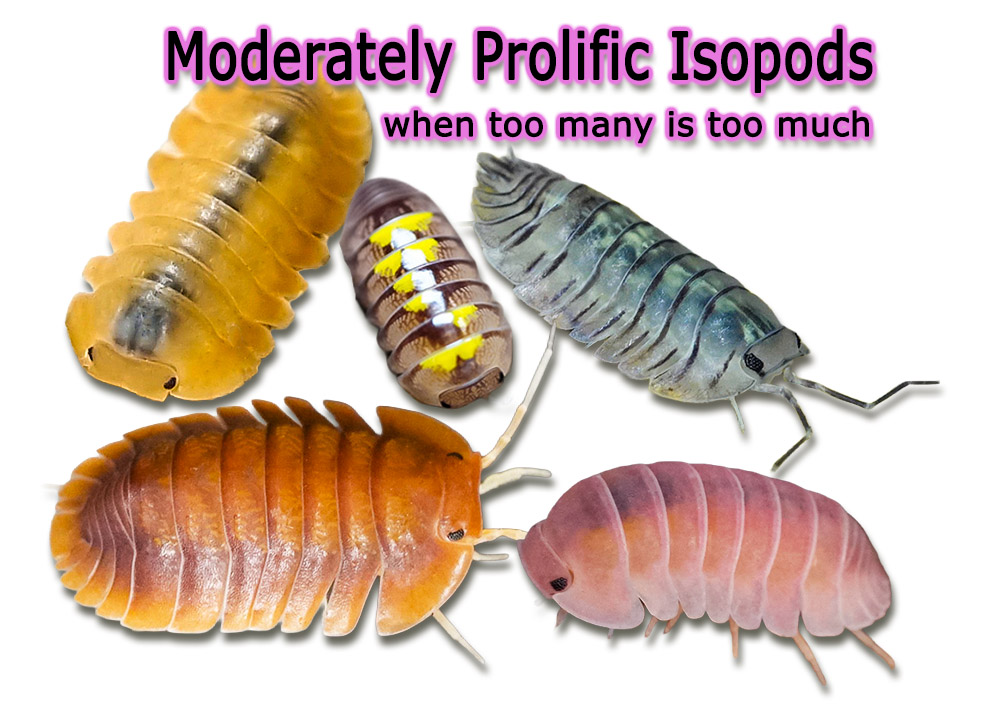
Introduction
I am often asked if I have isopods that are not breeding excessively, for example like the Porcellio laevis and the Porcellionides pruinosus. That gave me this idea to create this article and help more enthusiasts, especially when they wanted just an isopod for their bioactive setup, and in no time those Porcellio laevis or Porcellionides pruinosus overflowed it, and took over everything, destroying its harmonious look. So below is a list of those isopods that are moderately prolific.
List of isopod species
Below is a list in alphabetical order, of isopods that do not reproduce in extremely large numbers in beginner enthusiasts with isopods.
🐞 Armadillidae sp. ‘Devil Mask’ ↔ reproductive rate: 2
🐞 Armadillidae sp. ‘Electric Blue’ ↔ reproductive rate: 3 
🐞 Cubaris sp. ‘Amber Firefly’ ↔ reproductive rate: 2
🐞 Cubaris sp. ‘Blue Pigeon’ ↔ reproductive rate: 2
🐞 Cubaris sp. ‘Cappuccino’ ↔ reproductive rate: 2
🐞 Cubaris sp. ‘Caramel Cream’ ↔ reproductive rate: 1
🐞 Cubaris sp. ‘Cherry Blossom’ ↔ reproductive rate: 2
🐞 Cubaris sp. ‘Dark Phipun’ ↔ reproductive rate: 2
🐞 Cubaris sp. ‘Giant Nguyen’ (Crabby) ↔ reproductive rate: 3
🐞 Cubaris sp. ‘Honeymoon Tiger’ ↔ reproductive rate: 1
🐞 Cubaris sp. ‘Jupiter’ ↔ reproductive rate: 1
🐞 Cubaris sp. ‘Lemon Blue’ ↔ reproductive rate: 2
🐞 Cubaris sp. ‘Orange Freezy’ ↔ reproductive rate: 1
🐞 Cubaris sp. ‘Pak Chong’ ↔ reproductive rate: 1
🐞 Cubaris sp. ‘Red Edge Albino’ ↔ reproductive rate: 1
🐞 Cubaris sp. ‘Rubber Ducky’ ↔ reproductive rate: 2
🐞 Cubaris sp. ‘Silver Tiger’ ↔ reproductive rate: 3
🐞 Cubaris sp. ‘White Head Ducky’ ↔ reproductive rate: 2
🐞 Laureola sp. ‘Durian Spiky’ ↔ reproductive rate: 3
🐞 Schizidium rausi ↔ reproductive rate: 2
🐞 Spherillo sp. ‘Dream’ ↔ reproductive rate: 1
🐞 Troglodillo sp. ‘Camouflage’ ↔ reproductive rate: 1
🐞 Troglodillo sp. ‘Moth’ ↔ reproductive rate: 3
🐞 Troglodillo sp. ‘Porcelain’ ↔ reproductive rate: 3
🐞 Troglodillo sp. ‘Vex’ ↔ reproductive rate: 3
All these isopod species above do produce offspring normally, with some in that list being more prolific than others. I have set numbers to understand better which are more prolific (1) to moderately prolific (2) to slow breeders (3). The “more prolific” – in the number 1 group – means that you will see a good group of them if you lift up a cork bark, but again, nothing compared to other “more prolific” isopods, outside this list.
On a last note, you can keep all those isopods together, as they have the same similar requirements regarding humidity levels and temperature. If you are going to place them in a bioactive setup, make sure they have access both to a more moist area and a more dry area. Make sure as well that they have spots to go to, for example under a piece of cork bark, or other tree bark. Isopods don’t need a water dish like other pet animals, they “drink water” through their gills, located under their body at the rear section. Make sure as well to not offer too much protein (like gammarus shrimp, fish flakes or from our ready-made protein foods), only what they can eat in 24 hours. Their main diet consists of decaying leaf litter, white rotten wood, forest moss, lichen, limestone etc. Some tropical species from Vietnam and Thailand – like the Troglodillo species in this page – will require some bat guano as well. Some of them will require lichen as a staple diet, but not all of them. For the others lichen is like a “gourmet dish” so to speak. For individual care information on each species, click on their links above.
Check out also:
We provide fast, reliable shipping across the EU, including popular destinations like Germany, France, and Italy. See our full list of delivery locations here. Food and equipment are shipped worldwide.
 Exuvium Isopods
Leave a comment