
Captive bred invertebrates from a breeder in the Netherlands.
€20,00 per 20+ springtails
Interested?
cf. Tomocerus minor, springtail information > care > photos > video
Origin: Netherlands
Scientific name: cf. Tomocerus minor
Synonyms: Macrotoma minor, Tomocerus tridentifera, Macrotoma celer
Family: Tomoceridae (Collembola).
Common name: Dutch Giant Silver Springtail.
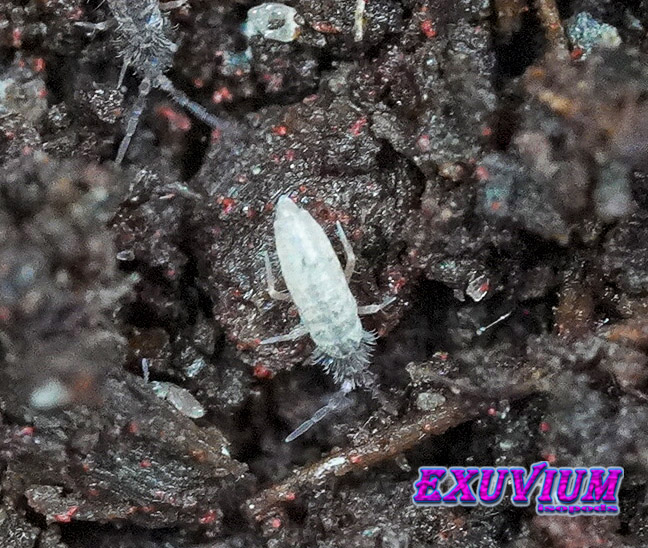
The Dutch Giant Silver Springtail (cf. Tomocerus minor) is a remarkably active and highly visible addition to any bioactive cleanup crew, measuring an impressive 3 millimeters—and capable of growing up to a staggering 4.5 millimeters—these elongated detritivores are significantly larger and faster than standard tropical white springtails. Their most captivating feature is their dynamic coloration; covered in microscopic scales, they exhibit a striking metallic silver or lead-grey sheen that often transitions to a deep, matte charcoal black as they age and actively forage through the substrate. Easily identified by their straight antennae—which are distinctly shorter than their bodies, allowing them to remain agile “runners”—they maneuver effortlessly through complex terrain. Perfectly adapted to temperate, damp climates, they thrive alongside isopods in moist enclosures with plenty of decaying bark, leaf litter, and fungi. Because they efficiently process mold, frass, and decaying organic matter without ever bothering their tank mates, these robust, cool-climate giants serve as both incredibly efficient custodians and fascinating display micro-fauna for your terrestrial setups.
cf. Tomocerus minor, springtails care
Size: adults may reach a length of 4.5 mm.
Activity: anytime; mostly night active.
Substrate: organic potting soil, or for best results check out our premium substrate. It should be kept damp at all times.
Temperature / Humidity: As a european springtail species Tomocerus minor does not need additional heating during winter. Temps can range from 10°C min. to 28°C max with optimal being to 22°C to 26°C. Create a humidity and temperature gradient by placing sphagnum moss on one side of the container, which does not need ventilation holes. Provide leaf litter or empty egg cartons for shelter.
Diet: While fish flakes are a popular protein supplement to boost breeding, the diet of the Dutch Giant Silver Springtail should primarily mimic their natural forest habitat rather than relying on commercial flakes alone. As enthusiastic detritivores and fungivores, their staple food source consists of the natural molds, microscopic fungi, decaying wood, leaf litter, and isopod frass already present in a bioactive enclosure. Supplemental foods—such as a tiny pinch of fish flakes, a sprinkle of active dry yeast, or a single grain of uncooked white rice—are excellent for encouraging rapid population growth, but they should be offered very sparingly to prevent spoiling the soil. Ultimately, a rich, damp substrate full of decaying organic matter provides all the essential nutrition these springtails need to thrive and keep your setup spotlessly clean. Check out also our Yield-Max Springtail Base substrate, ensuring it remains consistently moist but never completely waterlogged, decaying leaves, and white rotting wood. Also a calcium source (cuttlefish bone, limestone & oyster seashell, limestone rock) is a good idea, to keep them healthy.
Difficulty: easy.
Reproduction rate: moderate to prolific
Growth rate: normal to slow.
We provide reliable shipping across the EU, including popular destinations like Germany, France, and Italy. See our full list of delivery locations here.


 Exuvium Isopods