
Healthy, established colonies from a breeder in the Netherlands.
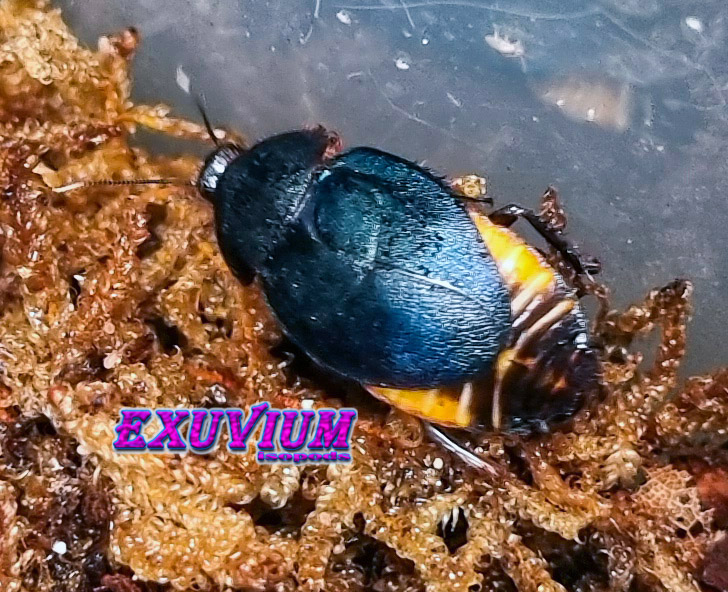
- €25,00 : 5x nymphs
- €40,00 : 10x nymphs
Interested?
Eucorydia yasumatsui, cockroach information > care > photos > video
Origin: SE Asia, Japan (Iriomote island), Taiwan.
Scientific name: Eucorydia yasumatsui
Family: Corydiidae
Basionym: –
Synonyms: –
Common names: Sapphire Flower Cockroach, Saffier bloemkakkerlak 🇳🇱, Saphir-Blumenschabe 🇩🇪, Blatte fleur de saphir 🇫🇷, Blatta fiore zaffiro 🇮🇹, Cucaracha flor zafiro 🇪🇸.
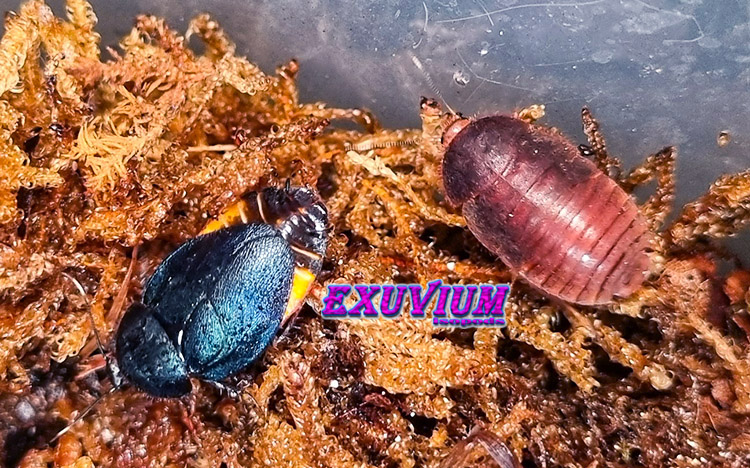
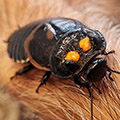
The Eucorydia yasumatsui, commonly known as the Sapphire Flower Cockroach, is a highly sought-after display species in the invertebrate hobby and it originally comes from SE Asia, with additional populations found on the Iriomote island in Japan and also in Taiwan. Because they look more like jewel-toned ornamental beetles than traditional roaches, they easily capture the attention of invertebrate hobbyists. They are famous for their iridescent, metallic sapphire-blue to bluish-black bodies, which are frequently contrasted with striking bright yellow markings under the wings, part of which is visible. The nymphs are brown colored and they cannot climb on smooth surfaces, but adults can.
They naturally inhabit humid, wooded areas, living primarily on the forest floor beneath decomposing vegetation and leaf litter.
Eucorydia yasumatsui, roach care
Size: adults may reach a length of 10 – 13 mm.
Activity: mostly night active.
Terrarium: keep ⅓ moist with moss and by spraying. It would be best if their substrate is at least 5 cm deep, as nymphs like to burrow in it. Yet males love to roam around on the high spots in the terrarium.
Temperature: 22 – 29°C
Humidity: 50 – 70%
Diet: they will enjoy soft fruit or even sweet potato and carrots. Also leaf litter and white rotten wood. They will require some protein as well which can be fish flakes. Don’t forget their weekly insect jelly. However, soft fruit can easily go bad and grow mold, but there’s a great alternative: dried fruit bites, that are extremely resistant to mold, for at least one week. I also add a piece of limestone rock in one corner of their enclosure.
Can climb?: the (brown) nymphs cannot climb on smooth surfaces but the adults can, with mostly the colorful adults being highly active. An escape-proof container is not needed, it can even be a 3 – 6 liter plastic container, but it’s better if it is tall.
Can fly?: only males can fly, but if the terrarium is small you won’t see them flying.
Difficulty: easy to moderate.
Reproduction rate: they may take a few months in the beginning to start reproducing, but after that they breed steadily. They go through a winter diapause (a period of suspended development).
Growth rate: moderate.
Lifespan: Nymphs might take 5 months to reach maturity. The adult male roaches live approximately 2 months and the adult female roaches a little longer than that. Lifespan and maturity have also to do with the temperature. So if it is a bit cold in your room, they live a bit longer but they will also take significantly longer to produce offspring.
We provide reliable shipping across the EU, including popular destinations like Germany, France, and Italy. See our full list of delivery locations here.


 Exuvium Isopods