
…or… “if I look like a Pill-Millipede probably you won’t try to eat me right? 🫣”
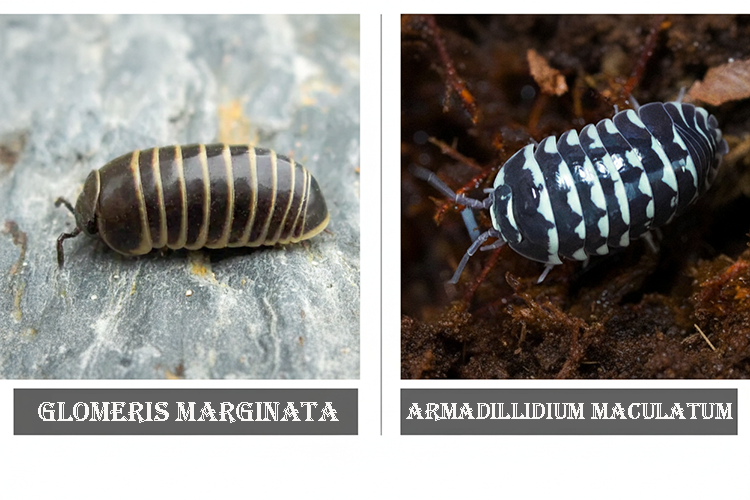
Origin of the Common name Zebra Isopod
The common name of the Armadillidium maculatum is Zebra Isopod and it’s purely descriptive of its bold black and white striped pattern, which bears a strong resemblance to a zebra. However, this pattern serves a functional purpose in nature:
⬥ Batesian Mimicry: Biologists believe the Zebra Isopod’s high-contrast pattern is a form of mimicry. It mimics the Pill Millipede (Glomeris marginata), a species that is native to the same regions.
⬥ The Survival Strategy: Unlike the isopod, the pill millipede secretes noxious, foul-tasting chemicals to deter predators. By looking like the “distasteful” millipede, the harmless Zebra Isopod tricks predators (like birds and spiders) into leaving it alone.
In nature, the white-striped variety is by far the most common. While you will see many “Yellow Zebras” in the pet trade, that specific coloration is almost exclusively a selectively bred morph (a genetic mutation isolated by breeders).
⬥ The Wild Type (white & black): In their native habitat of Southern France and the Mediterranean, the “Standard Zebra” is the dominant phenotype. They typically have a deep black or dark charcoal body with crisp, bright white markings. The “maculatum mystery”. Interestingly, the scientific name maculatum (meaning “spotted”) suggests that the original specimens studied by scientists actually had white spots rather than continuous stripes. In wild populations, you will see a mix: some have clean stripes, while others have rows of distinct white dots.
⬥ The Yellow Morph (Selective Breeding): The “Yellow Zebra” exists in nature as a rare genetic variation, but it does not thrive or dominate wild populations. In the wild, a yellow-striped Armadillidium maculatum would be a “mutation” that occurs once in a thousand individuals. Hobbyists found and isolated these rare yellow individuals and bred them together to “fix” the trait. So, if you buy a Yellow Zebra, it comes from a lineage where breeders have ensured the yellow trait “breeds true,” meaning the offspring will also be yellow.
Why White-striped isopods are more common than yellow-striped ones?
In the wild, the white and black contrast is more effective for the Batesian Mimicry mentioned earlier. The Pill Millipede (Glomeris marginata), which the Zebra Isopod mimics, is naturally black with thin creamy color stripes and margins. While the mimicry might seem mismatched at first glance, here is why the black-and-white Zebra Isopod (Armadillidium maculatum) is considered a mimic of the Pill Millipede (Glomeris marginata): To a predator like a bird or a lizard, the “white-on-black” pattern is a clear warning sign: “I taste like chemicals.” The “standard” Zebra Isopod matches this white-on-black color scheme perfectly, allowing it to “hide in plain sight” by looking like the chemical-producing millipede.
In the world of Batesian Mimicry, the exact shade (white vs. yellow) is often less important than the high-contrast pattern. Predators learn to avoid “high-contrast, banded/spotted bugs” because they associate that look with the noxious secretions of millipedes (which produce chemicals called glomerin). Whether the bands are white, cream, or yellow, the visual “message” remains the same: “Stay away, I’m toxic.” The Zebra Isopod survives by sending this false signal.
We provide fast, reliable shipping across the EU, including popular destinations like Germany, France, and Italy. See our full list of delivery locations here. Food and equipment are shipped worldwide.
 Exuvium Isopods
Leave a comment